

Glaucoma Dashboard
Revolutionizing Glaucoma Care with a remote monitoring medical device
and connected dashboard.
⏱︎ Read time: 2 minutes

Overview
At Zeiss Medical Technology, I helped design data-driven tools that streamline clinical workflows for ophthalmologists. With a team of 3 designers, I contributed to the first-ever remote glaucoma monitoring device, focusing on the progression-tracking feature and its data visualization.
Demoed at AAO 2022 to over 15,000 attendees, the product earned industry recognition and an internal innovation award.
Details
My role:
UX Designer & HF Engineer
Timeline:
Jun 2021 - Dec 2022 (shipped, not clear by FDA)
Responsibilities:
End-to-end on parts of the system
(Data Visualization, Reviewing Data, History Log)
Highlights
Improved glaucoma care by designing a remote monitoring dashboard that enhanced clinical workflows and decision-making.
Demoed in 2022
AAO conference over 15,000 attendees
Internal Innovation Award
ZEISS Award
Research Insights
Set a standard to guide other medical departments
Why is this important?
Reimagining lifelong disease management through remote monitoring
and human-centered design. A quick lesson into eye health and management.
What is Glaucoma?
Glaucoma is a group of eye conditions that damage the optic nerve, often due to elevated intraocular pressure (IOP). It’s a leading cause of irreversible blindness worldwide. The disease progresses slowly and silently, which makes regular monitoring essential—even when symptoms aren’t noticeable.
How is Glaucoma Severity Measured?
Doctors track glaucoma using tools like macular thickness scans and visual field heat maps through our Zeiss medical devices.
-
Macular thickness shows how much the central retina has thinned, which can signal disease progression.
-
Heat maps reveal areas of vision loss, helping monitor changes over time.
The Challenge of Traditional Glaucoma Care
Glaucoma care is a lifelong journey, requiring regular monitoring to prevent vision loss—but traditional tracking relies heavily on in-person clinic visits, which can be inconvenient and inaccessible for many. This makes it harder for patients to stay engaged and for providers to catch disease progression early.
From Clinic Dependent to Remote
Glaucoma care depends on frequent monitoring, but in-person visits can be limiting. Zeiss is transforming the experience with human-centered design and remote tracking to improve access and streamline care.

For Patients
Overcoming Barriers to Consistent Care
Glaucoma requires frequent checkups, but aging patients often struggle with mobility and transportation, making consistent trips to the clinic difficult.

For Ophthalmologists
Focusing More on Critical Cases
Busy clinics are often fully booked and spend time on routine progression scans every week, limiting resources for patients needing urgent injection treatments.

For the business (ZEISS)
Pioneering Glaucoma Monitoring
Zeiss is leading the shift to remote glaucoma tracking, providing real-time insights that reduce unnecessary visits and transform disease management.
Designing in the Unknown: Learning from Ophthalmologists
Building this first-of-its-kind product meant navigating ambiguity without existing models. I collaborated with doctors to understand their workflows, going on-site to observe how they manage glaucoma care.
01
Number of Patient Eye Scans
Ophthalmologists recommend that patients with progressing glaucoma scan their eyes at least 3x a week.
02
Patient Information Preferred View
Ophthalmologists view the date of birth in day, month, year format. OD (right eye) and OS (left eye) displayed reversed.
03
Heat Map Minimum Image Sizing
Ophthalmologists recommended the heat maps to not be smaller than 60x60 pixels or it would be too difficult to analyze.
04
Viewing Macular Thickness Change
Ophthalmologists need to set a baseline value of patient's most recent best state (um) to be compared with new scans.
05
Drug Injection View on MT Graph
Ophthalmologists analyze injection responses/ progression to determine the most effective treatment.
06
Looking Back at Reviewed Scans
Ophthalmologists frequently review past scans incrementally to compare glaucoma progression.
Shipped Designs
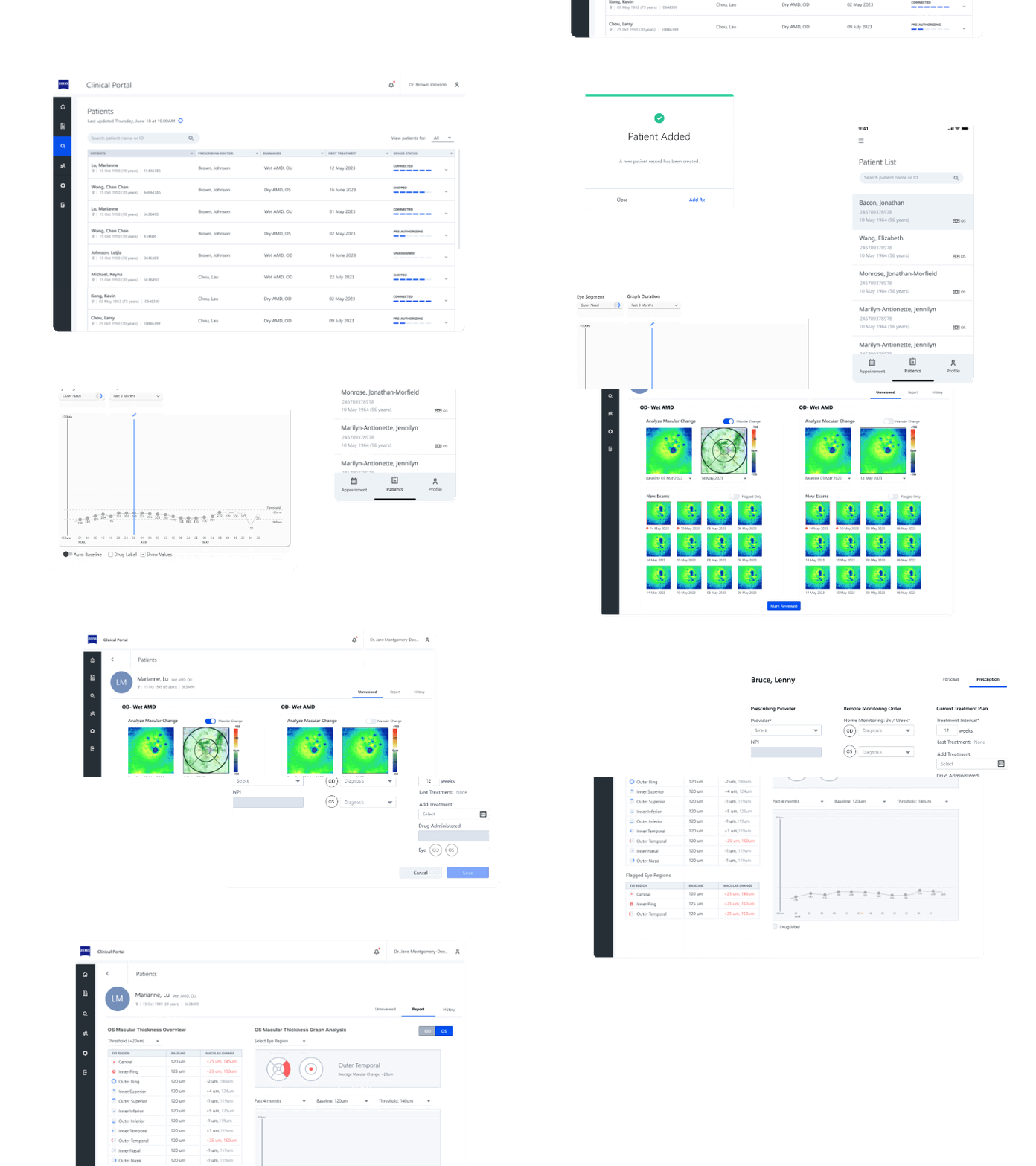
After months of rapid iteration in a Lean UX process, designing, testing with doctors, refining, and repeating; I contributed key features to the remote monitoring dashboard.

Data Visualization Dashboard
Allows doctors to track macular thickness trends over time. By comparing new eye scans against a patient’s baseline, doctors can better understand disease progression and make informed decisions about injections and treatment plans.

Reviewing New Eye Scans
A weekly review workflow where doctors assess new, unreviewed heat map eye scans to monitor disease progression—supported by a flagging system that highlights scans requiring urgent attention.

History Log of All Scans
a history log that stores all reviewed eye scans, allowing doctors to track progression over time and reference past injection treatments. This supports more informed and longitudinal care decisions.
Reach out to me to view anthropometrics research, mobile UI, and more!
Retrospective
What I would do differently
I wish I had spent more time upfront learning even more about the healthcare industry—especially EMR systems, patient management workflows, and clinical decision-making. As an early designer, I also found data visualization challenging and would have benefited from deeper knowledge of best practices for designing effective graphs. Gaining that context earlier would have made me even more confident in shaping the product.
Lessons
This was one of my earliest and most ambiguous projects—designing a first-of-its-kind platform with no existing benchmarks. Collaborating closely with doctors and stakeholders was key to uncovering workflows and medical context. I learned the value of documenting insights early, which helped me ramp up quickly and design with clarity.
Tradeoffs
Designing for healthcare often comes with the perception of being outdated or uninspiring—and I was determined to challenge that stigma. However, with the sheer volume of clinical data and the urgency of decision-making, functionality must always take precedence over aesthetics. Doctors need to move fast, and clarity is critical. Striking a balance between clean, intuitive visuals and high-performance utility became a core design challenge